“We treat every child the same.” It sounds fair. For a child whose needs make a standard sanction harder to meet, it often is not. This guide explains how to ask for reasonable adjustments to a school behaviour policy, how to build a log that school will take seriously, and why a child who is calm all day can fall apart the minute they get home.
I have sat in meetings where the behaviour policy was applied exactly as written, and the child it was written for was not the child in front of us. Here is how to shift that conversation. General information for England, not legal advice. Rules in Scotland, Wales and Northern Ireland differ, and your school’s behaviour policy will have the detail.
Understanding reasonable adjustments in respect of the behaviour policy
- “We treat every child the same”: what to say back
- Build a behaviour log school will take seriously
- Calm at school, chaos at home: what it tells you
- What to do this week
- Frequently asked questions
“We treat every child the same”: what to say back
Fair does not mean identical. The government’s Behaviour in Schools guidance says schools should consider whether reasonable adjustments are needed to a sanction for a pupil with SEND, and that alternative arrangements can be considered case by case. Check the current version before you quote it. Also check what your school says about reasonable adjustments in it’s behaviour policy.
The question to ask
“What reasonable adjustments have you considered for this sanction?” Then stop and let them answer. Remember that this is a polite question, and it is hard to answer with “none”.
Come with ideas, not just problems
- A break card or agreed way to leave a lesson
- Warning before a change of room or teacher
- A quieter route between lessons
- Fewer demands at the busiest times of day
- A named adult the child can go to
Open with “Could we try…” rather than “You should…”. Then ask for whatever is agreed to be written into your child’s support plan. Adjustments are not special treatment. They are what makes the rules possible for your child to follow.
Build a behaviour log school will take seriously
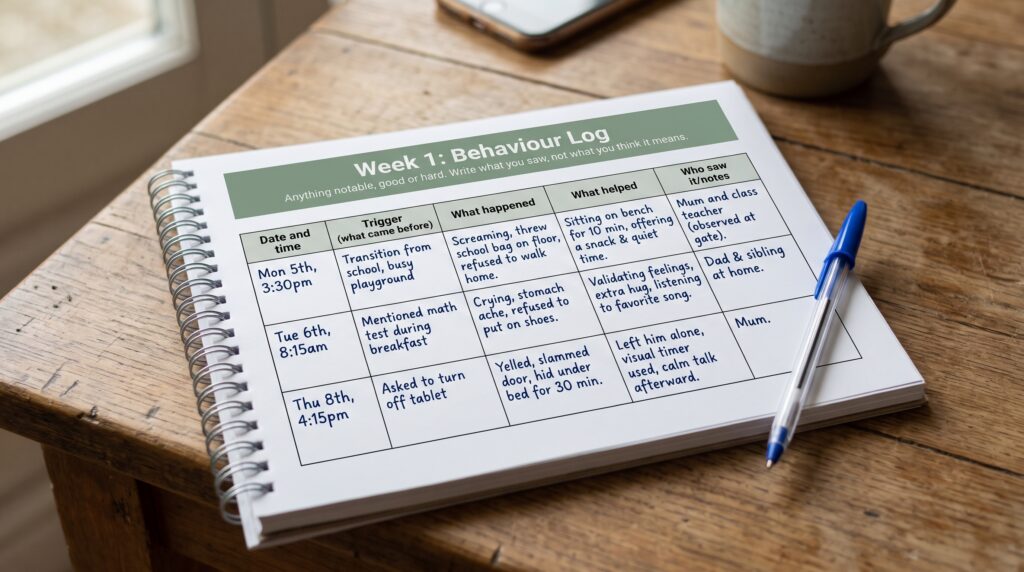
School records the behaviour. However, very few schools record what led up to it, or what home looks like afterwards, so that is the gap your log fills. Subsequently it also turns “I think it is getting worse” into dates and patterns.
What to write down, in three lines a day
- When and where: date, time, lesson or place, and who was there.
- What happened before: a demand, a change of plan, noise, hunger, a move to a new room, a different teacher.
- What your child did and said: their words if you can. Keep it factual and leave out your own judgement.
- What happened after: how long recovery took, what helped, what made it worse.
- Mornings and evenings: sleep, refusal to go in, meltdowns after school. They count as evidence too.
Keep it short and keep the paperwork
Simply put, recording three lines a day for four weeks is stronger evidence than one long account of a bad day. Put every email, text and letter from school in one folder, or one album of screenshots. Then, if a suspension or removal happens, you will already have the record, as I explain in what to do in the first 48 hours of a suspension.
Calm at school, chaos at home: what it tells you
If your child holds it together all day and then falls apart the second they get home, that is information, not bad behaviour. For many children, holding it together at school takes huge effort. Home is where it is finally safe to let it out. The PDA Society describes children who mask their difficulties to avoid confrontation.
It also means school may only see part of the picture. So tell them what your evenings and mornings look like.
How to use it in a meeting
- Log how long the collapse lasts, what helps and what the mornings look like.
- Say it plainly: “This is what holding it all together in school together is costing [insert child’s name]”.
- Ask whether the school day can include breaks, a quiet space, or fewer demands at the points where your child usually runs out of steam.
It is not an excuse. It is evidence.
What to do this week
- Start the log tonight. Three lines.
- Write down the one rule that is not working for your child, and one adjustment you would like to ask for.
- Put your request in an email, so there is a record. My guide to requesting an EHC needs assessment yourself includes a template email.
Frequently asked questions
What are reasonable adjustments in school?
Reasonable adjustments are changes that help a disabled pupil take part in school on a fair basis, such as advance warning of changes, a break card, or a different way to move between lessons. The behaviour guidance says schools should consider them when applying sanctions to pupils with SEND.
How do I ask for adjustments to a sanction?
Put it in writing. Ask what reasonable adjustments the school considered, suggest a few ideas, and ask for the agreed ones to be written into your child’s support plan.
What should a school behaviour log include?
Date, time, place and who was there, what happened before, what your child did and said, what happened after and how long recovery took, plus mornings and evenings. Three lines a day is plenty.
Why does my child behave at school but fall apart at home?
Many children use huge effort to hold it together at school, and home is where they feel safe enough to let it out. It is common, it is evidence, and it is worth telling school about.
Want the log template?
Download my free starter, SEND Parent Starter Guide, here. For scripts to use in the meeting, see the SEND School Meeting Toolkit.
Written by Evie Jones, parent coach and SEND advocate. I have been through this myself, and I help parents of children who are struggling with school find the next step. This is general information for England, not legal advice.